
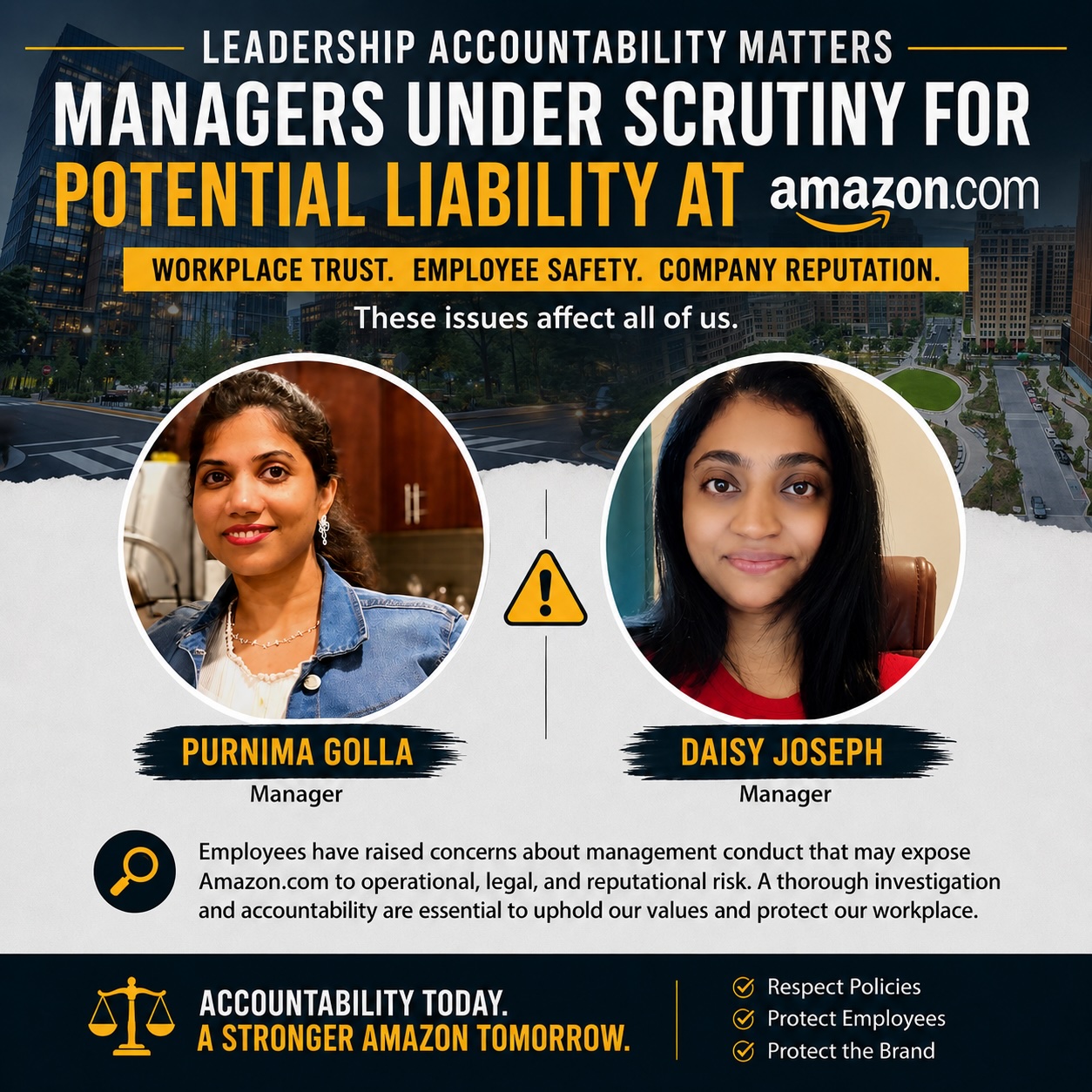
The Restricted Lab, the Denied Accommodation, and the Corporate Machine That Forgot the Human Being (Powered by JD Law Firm XVII™)
An anonymized story of disability, inhumane sourcing, protected reporting, alleged retaliation, and enterprise accountability inside Amazon.com, Inc.
There are companies that innovate.
There are companies that optimize.
There are companies that build devices, platforms, ecosystems, and global systems of labor so large that the public only sees the finished product: the package at the door, the smart speaker on the shelf, the device in the home, the frictionless service, the technology that seems to arrive without human cost.
And then there are companies whose internal systems become so massive, so procedural, so self-protective, and so clinically efficient that a human being inside the machine can be injured, destabilized, routed, classified, investigated, isolated, and exhausted while every department insists it followed its own process.
This is an anonymized account of one such case.
It begins inside Amazon’s Devices and Services organization, inside a confidential device-testing environment tied to unreleased products, restricted labs, automated testing, and the operational secrecy of a corporate technology pipeline. On paper, the case might look like an ordinary accommodation dispute. An employee requested work-from-home accommodation. Amazon denied it. The employee went through leave, disability, internal complaints, and long-term disability benefits.
But the record tells a larger story.
It is a story about inhumane sourcing.
Not sourcing in the narrow sense of materials or supply chains, but sourcing in the deeper corporate sense: where human capacity comes from, how it is extracted, how it is managed, how it is classified, and what happens when the human being who powers the corporate machine starts to break.
The employee worked in a role Amazon described as requiring on-site presence because the tasks involved testing unreleased confidential devices. Amazon’s stated reason for denying work-from-home accommodation was that the job position mandated on-site presence, that the work involved testing unreleased confidential devices, that automated tests had to run daily from the lab, and that the relevant space was an access-restricted lab in WAS19.
That language sounds operational.
It sounds neutral.
It sounds like the kind of explanation a company gives when it wants the dispute to be about business necessity rather than human harm.
But the central question is this: what happens when “confidentiality” becomes more than a business requirement? What happens when “unreleased confidential devices” becomes the reason a disabled worker cannot work remotely, cannot safely remain in the environment, cannot receive meaningful transfer support, and cannot get the company to treat the medical consequences as one coherent case?
What happens when a restricted lab becomes a restricted life?
The employee did not simply accept the denial. The employee challenged it. The employee stated that other people in the organization had been approved to work remotely regardless of the confidentiality of their projects. The employee stated that doctors, including a cardiologist and physician, had advised a change in job environment. The employee stated that they had scheduled appointments with a psychiatrist, therapist, and neurologist for injuries caused by unethical business and behavior practices. The employee said they were actively searching for roles in another organization, seeking support from HRBP for job changes, and afraid that current managers had limited support for internal transfers.
The employee then stated the sentence that should have changed the entire posture of the case:
remaining in the organization, especially WAS19, would not be sustainable for physical and mental health due to injuries caused by them.
That statement matters because it ties the medical condition, the accommodation request, the internal-transfer difficulty, and the work environment together. It points back to the Devices and Services organization. It points back to WAS19. It points back to the restricted-device rationale. It points back to management. It points back to Amazon.com LLC and, ultimately, to Amazon.com, Inc. as the parent company whose broader systems, policies, incentives, and operational demands may have made the harm possible.
This is where the story stops being merely procedural and becomes moral.
The employee was not asking for special treatment outside the business. The employee was asking the business to confront the human cost of its own internal sourcing model: place workers into restricted, high-pressure, confidential device-testing environments; require on-site presence because of unreleased products; deny remote accommodation because of operational secrecy; provide limited transfer support; route complaints through internal channels; place the worker on leave; classify the disability through benefits categories; and then force the worker to prove physical disability again and again while the corporation treats each stage as separate.
That is not care.
That is containment.
And containment is not humanity.
The Management Chain: Daisy Joseph, Purnima Golla, Courtney Childress, and the Devices and Services Organization
The record points to a specific management and HR chain.
Purnima Golla, Courtney Childress, and Daisy Joseph were copied on the accommodation denial. That matters because the denial was not simply an abstract decision by a faceless benefits office. It was routed through the Devices and Services organizational context where the worker’s role, restrictions, lab access, confidentiality requirements, transfer barriers, and management relationships existed.
Daisy Joseph, described as an L6 manager running her own organization under Amazon.com LLC, should be treated as a central management witness and potential decision-chain actor. The accommodation denial relied on an organization-specific justification: the employee allegedly had to be physically present because the Devices and Services role involved testing unreleased confidential devices in restricted WAS19 lab space.
That places Daisy Joseph near the organizational rationale used to deny accommodation.
The issue is not that Daisy must be presumed personally liable based only on being copied. The issue is that Daisy belongs in the chain of accountability because the denial’s justification came from the organization’s operational model. If the organization’s managers had discretion over who could work remotely, who could transfer, who received support, who was protected, and who was left unsupported, then Daisy’s role, communications, and managerial influence require discovery.
Purnima Golla also belongs in that chain. As another management figure copied into the denial, Purnima’s knowledge, communications, and role in the organization’s response matter. If the employee was reporting that managers were not supporting internal transfer efforts, then every manager in the relevant chain becomes important. The questions become simple: who knew, when did they know, what did they do, and what did they refuse to do?
Courtney Childress occupies a different but equally important position. Courtney entered the record as an HR escalation point. After the denial, she responded that she would set up a call to discuss the employee’s additional questions and concerns. She also addressed the employee’s leave-of-absence status, asking whether the employee was working or on LOA.
The employee clarified that they were not working, only checking emails and following up with hiring managers about possible transfer opportunities while still recovering from illness. The employee said they were on long-term recovery from illnesses and actively looking for a change of employment due to several concerns.
That exchange is not minor. It shows the employee trying to survive inside a corporate maze: not working, still recovering, still trying to transfer, still trying to understand leave status, still trying to navigate managers, HR, DLS, ERC, accommodation, and internal complaints.
The next day, the employee drafted a message to Courtney asking whether she had authority to file a work-related injury report for the cause of the medical leave. The employee wrote that DLS and ERC had recommended reaching out to file or report work-related illness and that the employee should receive a Sedgwick claim to help pay medical expenses.
This is one of the most important moments in the entire story.
The worker was not merely asking, “Can I be absent?”
The worker was asking, “Did this workplace cause or contribute to the medical leave, and how do I report that properly?”
That question should have triggered a coordinated, humane, legally careful response.
Instead, the broader record suggests fragmentation.
HR had one lane. Accommodation had another lane. DLS had another lane. ERC had another lane. Managers had another lane. Hartford had another lane. Workers’ compensation or Sedgwick had another lane. Internal investigations had another lane. Long-term disability had another lane. And the employee was left trying to make these lanes converge while physically and mentally unwell.
That is how corporate systems bury harm without ever saying the word “bury.”
Each department handles a piece.
Each department says the next department has the answer.
Each department asks for another form, another note, another clarification, another provider statement, another case number, another follow-up, another deadline.
But the human being only has one body.
The body does not experience HR, DLS, accommodation, workers’ compensation, ERISA, LTD, internal investigations, LinkedIn blocking, management avoidance, and benefits cutoff as separate systems.
The body experiences the totality.
The body experiences the environment.
The body experiences the injury.
The body experiences the denied accommodation.
The body experiences the unsupported transfer.
The body experiences the leave.
The body experiences the paperwork.
The body experiences the fear.
The body experiences the financial instability.
The body experiences the quiet message behind the process: survive the machine alone.
Internal and External Escalation: Protected Reporting Without Protection
Amazon had already acknowledged internal complaints through its Employee Investigation process. HR communications stated that the company had received the employee’s concerns and that it had a process to carefully review concerns raised to its attention. One acknowledgement indicated that someone might contact the employee personally to gather additional information if necessary. Another asked the employee for preferred contact information, time zone, translator needs, and preferred contact times.
Those acknowledgements matter.
They show that the employee was not merely complaining informally. The employee was operating through internal complaint channels. The employee was participating in protected reporting. The employee was escalating concerns internally. Later, the record also indicates escalation externally through attorneys, disability-benefits communications, and related legal or quasi-legal processes.
That means this case should be understood as a protected-activity case, not merely a medical paperwork case.
Protected reporting should trigger protection.
It should trigger non-retaliation safeguards.
It should trigger careful preservation of records.
It should trigger independence in investigation.
It should trigger management instructions not to interfere.
It should trigger support, not isolation.
But according to the employee’s account, no meaningful support was given while whistleblower protection was granted during the absence. That phrase captures the contradiction at the heart of the case: formal protection without practical protection. A status without a shield. A policy without a bodyguard. A promise without enforcement.
If whistleblower protection existed during the absence, the next question is unavoidable:
What did Amazon actually do to protect the employee?
Were retaliation safeguards communicated to Daisy Joseph, Purnima Golla, Courtney Childress, and the broader Devices and Services management chain?
Were managers instructed not to interfere with internal transfers?
Were managers instructed not to retaliate or isolate the employee?
Were internal investigations separated from the management chain whose conduct was being challenged?
Were HR case closures reviewed independently?
Were accommodation reviewers informed of the complaint history and work-related injury concerns?
Was the employee given support while on leave, or simply routed through process after process until the burden became unbearable?
The record demands those answers.
The HR Departure Red Flag: Courtney Childress, Confidential Cases, and the Bribery Suspicion
After escalating these issues internally and externally, the employee alleges that the HR figure involved in the escalation chain left the company after closing confidential reported cases that had been reported internally and externally.
According to the employee’s account, Courtney Childress investigated 30+ cases, closed all confidential reported cases, and then left the company the next day. The employee suspects that she took a bribe.
That allegation is serious.
It should not be stated as proven without records. It requires evidence. It requires documentation. It requires case logs, closure dates, assignment records, investigator notes, employment status records, role transition records, separation documentation, conflict disclosures, severance records, unusual compensation records, communications with management, communications with legal, and any internal ethics or compliance review tied to her departure.
But the allegation should not be ignored either.
Because if an HR actor handled or influenced dozens of confidential reported cases, closed sensitive matters after internal and external escalation, and then left the company immediately afterward, the timing alone becomes a major investigative red flag.
The public does not need to assume bribery to understand why the question matters.
The question matters because HR is supposed to be the internal safeguard. HR is supposed to protect process integrity. HR is supposed to ensure that complaints are reviewed, retaliation is prevented, leave is coordinated, accommodation is handled lawfully, and workers are not abandoned while navigating protected channels.
But if the HR process itself becomes suspect, the entire system becomes suspect.
The allegation of bribery, improper influence, conflict of interest, inducement, or quiet internal pressure should be investigated through records. The relevant question is not only whether money changed hands. The relevant question is whether any benefit, pressure, protection, favor, severance arrangement, role transition, legal strategy, management instruction, or internal incentive influenced the closure of confidential reported cases.
That is the deeper issue.
Bribery can be direct.
Improper influence can be indirect.
Corporate self-protection can be formal, informal, financial, reputational, managerial, or procedural.
A company does not need to write “retaliate” in an email to retaliate.
A company does not need to write “bury this” in an email to bury it.
A company does not need to admit “we protected the organization” for the record to show a pattern of containment.
If Courtney Childress closed numerous confidential cases and left immediately afterward, investigators should ask: what cases were closed, who approved closure, what findings were made, what evidence was reviewed, what evidence was ignored, what support was provided, who benefited, and why did the HR actor leave at that time?
Until those records are produced, the bribery issue remains an allegation and investigative question.
But the question itself is legitimate.
Because when a disabled worker escalates protected complaints, an HR actor tied to confidential investigations allegedly closes the cases and exits, and the worker receives no meaningful support, the public has a right to ask whether the system investigated harm or neutralized exposure.
The LinkedIn Social Platform Blocking: Professional Isolation After Protected Activity
The employee also alleges that managers who ran the organization blocked the employee from their LinkedIn social platform.
On the surface, some might dismiss that as a personal social media issue.
That would be a mistake.
LinkedIn is not merely social media. For workers, especially workers seeking internal transfer, external employment, professional rehabilitation, references, credibility, network continuity, and career recovery, LinkedIn is an employment-adjacent professional platform. It is a social platform, yes, but it is also a labor-market platform. It is where professional identity, visibility, opportunity, and reputation are maintained.
So when managers connected to the organization allegedly block a disabled employee after internal and external escalation, that conduct belongs in the record.
Not as the central harm.
As behavioral evidence.
The question is not whether a manager has a general right to control a personal account. The question is whether the blocking happened after protected activity, whether multiple managers did it, whether it was coordinated, whether it followed internal complaints or external escalation, whether it reflected avoidance, whether it interfered with transfer or references, and whether it formed part of a broader pattern of ostracism, reputational containment, retaliation, or professional isolation.
If managers running the organization blocked the employee on LinkedIn after the employee reported disability, accommodation problems, workplace injury concerns, and internal complaints, investigators should ask what they were avoiding.
Were they avoiding contact?
Were they avoiding visibility?
Were they avoiding accountability?
Were they avoiding the worker’s public professional identity?
Were they avoiding a record of association?
Were they distancing themselves because HR or legal told them to?
Were they closing ranks?
Were they cutting off a worker whose professional life had already been destabilized by the organization?
The LinkedIn blocking should be documented with screenshots, dates, profile names, titles, timing relative to protected activity, and any evidence showing whether the blocking was individual or coordinated. It should be compared against internal communications instructing managers not to communicate with the employee, not to support transfer, not to provide references, or to route everything through HR/legal.
This issue matters because retaliation is not always a termination letter.
Sometimes retaliation is silence.
Sometimes it is isolation.
Sometimes it is being blocked from the very professional networks that could help a worker rebuild.
Sometimes it is being treated as radioactive after asking the company to follow the law.
Hartford, LTD, Physical Disability, and the Mental-Health Limitation
The later disability-benefits record shows why the Amazon workplace context matters.
The Hartford, administering long-term disability benefits connected to Amazon, later treated the claim as approved primarily under mental-health conditions. The carrier stated that mental-health benefits were limited under Amazon’s policy to 24 months, from March 25, 2024 through March 24, 2026. At the same time, the carrier acknowledged that physical conditions were noted throughout the record, but indicated that physical disability would need to be separately endorsed by a provider to potentially extend benefits beyond the mental-health limitation.
That is the trap.
The physical conditions were there.
The workplace-injury concern had been raised.
The employee had asked HR about filing a work-related injury or illness report.
The employee had said the workplace was not sustainable for physical and mental health due to injuries caused by them.
But the benefits system still treated the claim as mental-health-limited unless physical disability was separately documented in the precise form the carrier required.
This is how corporate harm can be laundered through classification.
A worker says the workplace environment is medically unsustainable.
The worker asks about work-related injury or illness reporting.
Physical conditions appear throughout the disability record.
But the benefits pathway narrows the case into a mental-health limitation unless the worker can produce another layer of physical-disability documentation.
Then, when the clock runs out, the worker is told the claim will terminate unless the right forms arrive.
That is not merely bureaucracy.
It is procedural compression.
The worker’s lived reality is compressed into categories: mental health, physical health, accommodation, leave, injury, transfer, investigation, benefit period, provider form, maximum benefit date.
Each category has its own gate.
Each gate has its own deadline.
Each missed or disputed gate becomes a way for the system to say no.
The machine does not have to deny the whole person at once.
It only has to deny one category at a time.
The Parent Company Question: Amazon.com, Inc. and Enterprise Accountability
This case should not be contained inside a lower-level HR file, a Devices and Services management chain, Amazon.com LLC, or a benefits administrator’s LTD decision.
It raises a broader enterprise accountability issue involving Amazon.com, Inc. as the parent company.
The employee’s dispute arose inside Amazon’s Devices and Services ecosystem, in a role tied to unreleased confidential devices, restricted lab access, WAS19, and on-site testing. That operational justification was used to deny work-from-home accommodation. But the same record shows the employee reporting that physicians advised a change in job environment, that others allegedly received remote-work flexibility despite confidentiality concerns, that managers were not supporting internal transfer efforts, and that remaining in the organization was not sustainable for physical and mental health.
That is not merely a local scheduling dispute.
It is a window into how a parent enterprise sources, places, manages, retains, classifies, and exits human labor inside high-pressure confidential product environments.
If Amazon.com, Inc. benefits from the Devices and Services organization, directs or benefits from its confidential product-development pipeline, sets enterprise-wide HR expectations, funds or controls disability and leave systems, and relies on centralized accommodation, DLS, ERISA, LTD, internal investigation, and benefits processes, then accountability should not stop at the lowest named manager or the benefits vendor.
The relevant question is whether the parent enterprise created, approved, tolerated, or failed to correct an integrated system that converted a disabled worker’s medical deterioration into a maze of fragmented procedures.
Did Amazon.com, Inc. and its operating entities use organizational complexity to turn a workplace-created disability concern into a benefits-classification problem?
Did Amazon.com, Inc. benefit from confidential device labor while insulating itself from the consequences of that labor?
Did Amazon.com, Inc. centralize control while decentralizing accountability?
Did Amazon.com, Inc. allow the worker to be processed through HR, DLS, ERC, accommodation, internal investigations, workers’ compensation, Hartford, and LTD as if each process had no responsibility to the whole person?
That is the parent company question.
It is not only legal.
It is ethical.
The Legal Theory: Integrated Enterprise, Joint Employer, Agency, Good-Faith Interactive Process, Retaliation, ERISA, and Workers’ Compensation
A legal theory does not need to begin with an accusation of personal motive.
It can begin with structure.
The relevant structure here is an integrated Amazon system: Devices and Services operations, local management, HRBP, DLS, ERC, accommodation review, internal complaint handling, leave administration, workers’ compensation routing, ERISA, LTD benefits, and external claims administration.
Each part may appear separate on paper.
But for the worker, they operated as one continuous employment system.
Several legal theories may be implicated.
First is integrated enterprise or centralized control. If Amazon.com, Inc. or its operating entities exercised centralized control over HR policies, leave systems, accommodation procedures, internal investigations, benefits administration, or Devices and Services labor design, then parent-level accountability may become relevant. The question is not merely which entity appears on a paycheck. The question is who controlled the policies, decision pathways, management incentives, and procedural architecture that governed the worker’s accommodation, leave, investigation, transfer, injury reporting, and benefits outcomes.
Second is joint employer or operational control. If the parent company or affiliated entities controlled essential terms of employment, job placement, restricted work requirements, accommodation procedures, transfer opportunities, or leave consequences, then the worker’s harm may be traceable to an enterprise-level employment system rather than a single local supervisor.
Third is agency. Managers and HR personnel acting within the scope of their roles may create liability for the entity or entities they served. Daisy Joseph, Purnima Golla, and Courtney Childress should therefore be examined not only as individuals, but as agents within Amazon’s management and HR structure. Their communications, approvals, omissions, case handling, and escalation decisions may reveal whether the company acted through them.
Fourth is failure to accommodate and failure to engage in a good-faith interactive process. The employee reported medical restrictions, sought work-from-home accommodation, identified job-environment concerns, pursued internal transfer support, and raised the possibility of work-related injury or illness. If the company denied remote work based on confidential-device requirements without adequately considering alternatives such as reassignment, modified duties, temporary remote work, alternative lab scheduling, quieter workspace, reduced exposure, transfer, or other reasonable accommodations, the interactive process may have failed.
Fifth is retaliation or interference. The employee had engaged in protected activity by raising internal complaints, seeking accommodation, taking medical leave, asking about work-related injury or illness reporting, and escalating internally and externally. If support deteriorated, transfer pathways narrowed, investigations were closed without meaningful remediation, managers blocked the worker on LinkedIn, HR exited after sensitive case closures, or benefit classifications were handled in a way that penalized protected reporting or medical leave, then retaliation and interference theories require scrutiny.
Sixth is ERISA and disability-benefits administration. Hartford’s later communications show that the claim was approved under a mental-health framework while physical conditions were noted throughout the record. If the physical-disability evidence was minimized, misclassified, or not fairly developed despite workplace-injury indicators and prior requests to report work-related illness, then the LTD record should be examined for procedural irregularity, arbitrary benefit limitation, failure to consider relevant evidence, and failure to give the claimant a fair opportunity to substantiate physical disability.
Seventh is workers’ compensation and workplace injury routing. The employee asked HR whether a work-related injury report could be filed for the cause of the medical leave. If the company failed to assist, failed to route the report properly, failed to preserve evidence, or discouraged the worker from pursuing a workplace-injury claim, that may become a separate evidentiary and legal issue.
Eighth is conflict of interest, improper influence, and potential bribery. If an HR actor handled 30+ confidential cases, closed all confidential reported cases after internal and external escalation, and left the company the next day, investigators should examine whether any improper influence, inducement, severance, internal pressure, conflict, or potential bribe affected the handling of those cases. This must be proven through records, but it belongs in the investigative theory.
Ninth is professional isolation and reputational containment. If managers who run the organization blocked the employee from their LinkedIn social platform after protected activity, that should be examined as behavioral evidence of retaliation, avoidance, ostracism, or coordinated distancing.
The Discovery Needed
The next phase should focus on records, not speculation.
The worker should seek all communications and records involving Daisy Joseph, Purnima Golla, Courtney Childress, HRBP, DLS, ERC, Devices and Services leadership, Amazon accommodation personnel, Amazon investigation personnel, Hartford, Sedgwick, workers’ compensation representatives, benefits personnel, legal, and any relevant management chain concerning:
the work-from-home accommodation denial;
the WAS19 restricted-lab rationale;
confidential unreleased devices;
automated testing requirements;
remote-work comparators;
employees allegedly approved to work remotely despite confidentiality concerns;
manager input submitted during the accommodation review;
internal transfer requests;
manager support or lack of support for transfer;
medical restrictions;
provider recommendations to change job environment;
physical and mental health concerns;
injuries caused by unethical business and behavior practices;
the employee’s statement that WAS19 was not sustainable for physical and mental health due to injuries caused by them;
internal complaints;
external complaints;
Employee Investigation acknowledgements;
confidential reported cases;
case assignment logs;
30+ cases allegedly investigated by Courtney Childress;
case closure dates;
closure rationale;
investigator notes;
Courtney Childress’s role, case authority, case volume, case closures, role change, departure timing, and last day of employment;
any bribery, improper influence, inducement, conflict, severance, unusual compensation, or ethics review records;
communications with Daisy Joseph;
communications with Purnima Golla;
communications with Courtney Childress;
communications involving Amazon.com LLC;
communications involving Amazon.com, Inc.;
whistleblower protection records;
non-retaliation instructions;
records showing what support was or was not provided while whistleblower protection was granted during the absence;
work-related injury reporting;
work-related illness reporting;
Sedgwick claim routing;
DLS and ERC guidance;
Hartford LTD records;
mental-health limitation analysis;
physical-disability documentation requests;
provider forms;
workers’ compensation documents;
LinkedIn blocking evidence;
dates and screenshots of managers blocking the employee from their LinkedIn social platform;
communications instructing managers not to speak to or support the employee;
communications about legal risk, reputational risk, or containment.
This discovery is necessary because the story cannot be fully understood from one denial email, one HR acknowledgement, one LTD communication, or one manager’s name.
The harm appears architectural.
And architecture leaves records.
Why Investors, Listeners, Supporters, Ex-Employees, and the Public Should Care
For investors, this is governance risk.
A company that can hide human harm inside fragmented HR and benefits systems may also be hiding litigation risk, compliance risk, cultural risk, disability-access risk, retention risk, whistleblower risk, ERISA risk, workers’ compensation risk, and reputational risk. Investors should not only ask whether Amazon can build devices. They should ask what the human infrastructure behind those devices costs, and who pays that cost when the worker breaks.
For listeners and supporters, this is a story about the gap between corporate language and human reality.
The company has processes.
The company has case numbers.
The company has HR acknowledgements.
The company has DLS.
The company has ERC.
The company has accommodation review.
The company has internal investigations.
The company has benefits administrators.
The company has policies.
The company has confidentiality agreements.
The company has restricted labs.
The company has managers.
The company has lawyers.
But did the company have care?
For ex-employees, this is pattern recognition.
How many workers were told their role could not be accommodated because of business necessity?
How many were pushed toward leave instead of reassignment?
How many were told to seek transfer while managers quietly failed to support transfer?
How many internal complaints were acknowledged, investigated, and closed without meaningful protection?
How many workers saw medical conditions split into categories that made benefits easier to limit?
How many people were blocked, isolated, avoided, or professionally cut off after protected activity?
How many were made to feel that the company had a process for everything except responsibility?
For current employees, this is a warning.
If a worker becomes sick inside a confidential organization, will the company protect the worker or the project?
If a worker asks for accommodation, will the company search for a real solution or defend the existing workflow?
If a worker reports harm, will HR investigate independently or manage exposure?
If a worker asks about work-related injury, will the company help file the claim or let the question disappear into procedural silence?
If a worker is granted whistleblower protection during absence, will support actually follow?
If managers block the worker from LinkedIn, will the company call it personal choice or recognize it as professional isolation after protected activity?
If an HR actor leaves after closing confidential reported cases, will the company investigate or look away?
For advocates, this is a disability justice issue.
No disabled worker should have to become a lawyer, investigator, benefits analyst, medical-record coordinator, whistleblower, social media archivist, and public advocate just to prove that their body was harmed and their employer knew enough to do better.
No worker should have to fight a parent company, managers, HR, DLS, ERC, Hartford, Sedgwick, internal investigations, legal classifications, and professional isolation at the same time.
No worker should be forced to carry the entire evidentiary burden while the enterprise that controls the records hides behind fragmentation.
The Moral Problem
The moral problem is already visible.
A worker inside a restricted corporate machine reported harm, asked for accommodation, sought transfer, raised internal concerns, escalated externally, went on leave, asked about work-related injury, and later faced a benefits system that acknowledged physical conditions while constraining the claim under a mental-health limitation unless more documentation was produced.
The worker alleges that after escalating these issues internally and externally, the HR figure involved in confidential case handling left the company, raising suspicion of bribery or improper influence.
The worker alleges that managers who run the organization blocked the employee from their LinkedIn social platform, creating a further pattern of professional isolation after protected activity.
The worker alleges that no meaningful support was provided while whistleblower protection was granted during the absence.
These allegations require records.
But the human pattern is already clear.
The system did not respond like a community trying to protect a person.
It responded like a machine trying to protect itself.
The Final Accountability Question
Amazon’s public brand is built on speed, scale, intelligence, customer obsession, logistics, devices, cloud infrastructure, automation, and innovation.
But the hidden test of a corporation is not how fast it can deliver a package or ship a device.
The hidden test is what it does when the worker behind the system breaks.
Does it repair?
Does it accommodate?
Does it transfer?
Does it protect?
Does it investigate honestly?
Does it preserve benefits?
Does it prevent retaliation?
Does it stop managers from isolating the worker?
Does it investigate suspicious HR departures?
Does it treat whistleblower protection as real protection?
Does it take responsibility?
Or does it route the worker through enough processes that exhaustion becomes the final denial?
This story points to a larger corporate truth: the future of technology cannot be built on the quiet collapse of the people asked to produce it.
If Amazon.com, Inc. wants to be seen as an innovation company, then it must answer a basic ethical question:
What kind of innovation requires a worker to become disabled, disbelieved, procedurally trapped, socially blocked, professionally isolated, financially endangered, and forced to fight through fragmented systems before anyone asks whether the system itself is the problem?
The record points to Devices and Services.
It points to WAS19.
It points to restricted unreleased confidential devices.
It points to the work-from-home accommodation denial.
It points to Daisy Joseph.
It points to Purnima Golla.
It points to Courtney Childress.
It points to Amazon.com LLC.
It points to Amazon.com, Inc.
It points to internal complaints.
It points to external escalation.
It points to whistleblower protection without support.
It points to a requested work-related injury report.
It points to work-related illness.
It points to Sedgwick.
It points to Hartford.
It points to physical conditions noted throughout the record.
It points to a mental-health limitation.
It points to long-term disability termination risk.
It points to the allegation that HR left after closing confidential reported cases.
It points to the suspicion that she took a bribe.
It points to managers blocking the employee from their LinkedIn social platform.
It points upward, toward the parent company.
Because in a corporation this large, harm does not happen only through one person’s decision.
Harm happens through architecture.
And architecture has authors.
Sources and References
This article is based on an anonymized review of employment, accommodation, internal complaint, leave, long-term disability, and attorney/carrier correspondence records, including:
Amazon HR acknowledgement emails confirming receipt of internally reported concerns and describing Amazon’s employee investigation process.
Amazon Disability & Leave Services accommodation correspondence concerning claim A-2024-952183, including the denial of work-from-home accommodation based on alleged on-site requirements for testing unreleased confidential devices in restricted WAS19 lab space.
Amazon leave decision correspondence concerning leave, FMLA, and short-term disability benefits.
Correspondence involving HR/management figures including Courtney Childress, Purnima Golla, and Daisy Joseph.
Correspondence in which the employee asked HR about filing a work-related injury or work-related illness report and obtaining a Sedgwick claim.
Hartford long-term disability correspondence concerning LTD approval, mental-health benefit limitations, physical conditions noted in the record, physical-disability documentation, and potential benefit termination.
Attorney correspondence concerning LTD appeal status, administrative review, physical attending physician forms, workers’ compensation documents, and related benefits issues.
The article also references general legal concepts including reasonable accommodation, protected activity, retaliation, workers’ compensation routing, ERISA disability-benefits review, agency, joint employer/control, integrated enterprise, and parent-company accountability.
Disclaimer
This article is an anonymized narrative and commentary based on documents, correspondence, and the employee’s account. It is intended for public-interest discussion, advocacy, and investigative review.
Some statements are documented by records. Other statements, including allegations regarding improper influence, bribery, HR departure timing, case closure practices, LinkedIn blocking, retaliation, management motive, and enterprise-level liability, are presented as allegations, concerns, or investigative questions unless independently proven by records.
Nothing in this article should be read as a final legal finding, court determination, or proven conclusion of liability. The article does not accuse any individual or entity of criminal conduct as an established fact. Any allegations of bribery, corruption, retaliation, discrimination, or misconduct require further investigation, discovery, corroborating documents, witness testimony, and legal review.
This article is not legal advice. Readers facing similar issues should consult a qualified attorney, labor advocate, disability-rights advocate, or appropriate government agency.
Names and identifying details may be omitted, generalized, or anonymized to protect privacy, safety, medical confidentiality, and the integrity of any ongoing or future legal, administrative, or investigative process.